
Our Story

History – Culture
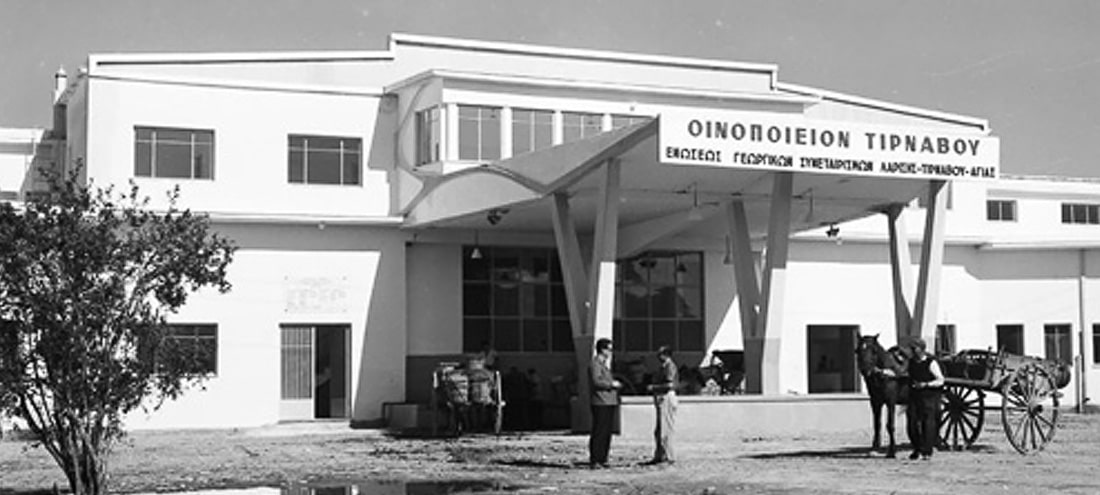
For centuries, the production of wine and spirits in the region of Tyrnavos has been at the heart of the area’s economic, social and cultural life. The wine, tsipouro and ouzo produced here stand as a living monument of local heritage. A significant part of this long history in more recent years is the Agricultural Cooperative Winery & Distillery of Tyrnavos, which, since its establishment in 1961, has highlighted and advanced both the production and the deep-rooted tradition of the Tyrnavos vineyard and its products.

Tyrnavos Vineyards
Terroir
The Tyrnavos vineyard encompasses the vine-growing areas of the municipal districts of Tyrnavos, Ampelonas, Argyropouli, Damasi, Deleria, Dendra–Platanoulia, and Rodia. It covers a total area of 2,300 hectares, of which 1,700 hectares are planted with wine-producing varieties, the most prominent being the red Moschato Tyrnavou (1,200 hectares). This variety has become so closely associated with the Tyrnavos region that the area is now widely known as Tyrnavos of Moschato, since its cultivation elsewhere in Greece is limited.
The members of the Agricultural Cooperative Winery & Distillery of Tyrnavos cultivate 930 hectares. The largest area is planted with Moschato Tyrnavou (590 hectares), followed by Roditis (Alepou) with 160 hectares.
White grape varieties—both indigenous and international—cultivated in the region, listed according to the area they occupy, include Ugni Blanc, Macabeo, Assyrtiko, Sauvignon Blanc, White Muscat, Batiki (an old variety found mainly in Tyrnavos), Chardonnay, Debina, Malagousia, and Savatiano. Red varieties—indigenous and international—include Merlot, Syrah, Limniona (a native variety of Thessaly), Cabernet Sauvignon, Xinomavro, Grenache Rouge, and Alicante.
The monitoring of the members’ vineyards, systems, and cultivation programs is carried out by the Cooperative’s well-staffed agronomy department.
Since 2004, the Cooperative has implemented an integrated management system in accordance with AGRO 2-1 and AGRO 2-2 standards. This environmentally friendly production method is based on the rational use of all cultivation inputs (water, fertilizers), the reduction of plant-protection products, and the controlled application of cultivation practices. Its aim is to produce safe, certified-quality agricultural products while protecting growers, consumers, and the environment. Member vine-growers are required to follow specific production rules and keep records of all practices applied.
Within the framework of integrated management, and extensively since 2019 through action 70-1.3.2 of the Ministry of Rural Development and Food, the method of mating disruption for the grapevine moth (using confusion traps) has been applied. Since 2024, the same technique has been used to control the vine mealybug, with the goal of minimizing or even replacing chemical pest control for these two major vineyard threats.
Cultural Monument
Our Tradition
“Μήδεν άλλο φυτεύσεις πρότερο δένδρον αμπέλω” (first of all trees, plant the vine). This advice from the ancient poet Alcaeus seems to have been followed by the ancestors of Tyrnavos, and to this day the vine remains the backbone of the town’s economy. Its products—wine and tsipouro—are ever-present companions in every social expression of the town and often at the very center of them.
The phrase that has survived to our days, “όλα αμπέλια” (meaning “let all land be planted with vines”), used as a wish, a toast, or a form of encouragement, reflects the deep respect the locals have for the vine.
Wine in the Tyrnavos region is a true cultural monument, even though it is produced and consumed today, because it carries within it the skill and the sweat of people—not only of the present but of many generations before. The place of wine in society is the result of its long journey through the town’s history. Even the strains of yeast endemic to the region, which shape the wine’s production, stand as living witnesses to this historical evolution.
The vine thrives in Tyrnavos, and wine plays a decisive role in shaping the character of its inhabitants, as described in 1817 by the scholar Ioannis Oikonomou from Larisa: “…the people of Tournavos are devout, and to the utmost degree lovers of joy and celebration, so much so that it is rare not to encounter a true wine-lover among them.” And again: “Those of Tyrnavos who had wine for sale at their homes would hang a branch of a tree to show it. Whoever saw the branch hanging over the courtyard gate would enter freely and taste the wine to judge whether he wished to buy it or not.” This excerpt, from Leonardos’ “Chorography of Thessaly” (1832), shows that the history of the vine and its products in Tyrnavos is centuries-long and stretches deep into the past of the region.
”“μήδεν άλλο φυτεύσεις πρότερο δένδρον αμπέλω”
AlcaeusAncient Greek Poet
(first of all trees, plant the vine)
”“μήδεν άλλο φυτεύσεις πρότερο δένδρον αμπέλω”
ΑλκαίοςΑρχαίος Ποιητής
(first of all trees, plant the vine)
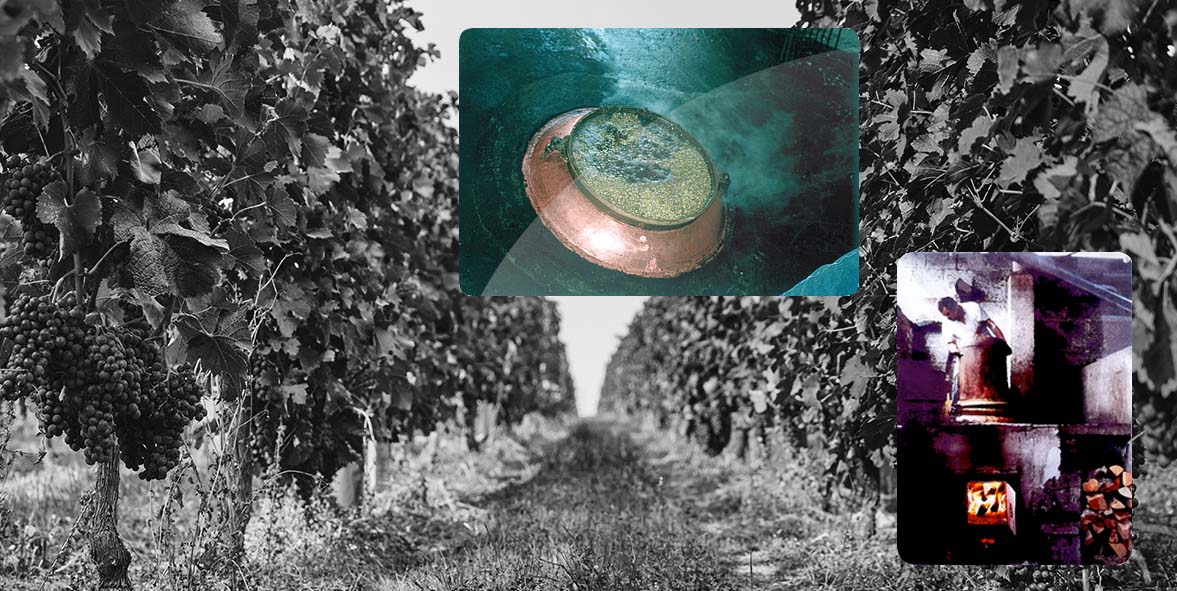
The Town of Tyrnavos in the late 18th century was known for its famous dyed yarns and for the excellent-quality silkworm cocoons it produced—many of the finest were even exported. What truly made Tyrnavos renowned throughout Greece (and beyond), however, was Tsipouro of Tyrnavos (Ouzo). This fine spirit was produced by re-distilling pomace distillate, enriched with anise and other aromatic herbs. It was during this period that the high-quality, double-distilled Tsipouro began to be referred to as “Ouzo,” derived from the well-known expression of a local citizen who, upon tasting it, exclaimed: “But this is uso Massalia!” expressing his admiration by comparing it to a high-quality product destined for the port of Marseille. Thus was born the myth of Ouzo of Tyrnavos, which was nothing more than excellent double-distilled Tsipouro. Although this descriptive name was eventually lost over time, Tsipouro of Tyrnavos itself became a gift to all of Greece—and to the world.
The exact origins of tsipouro production in Greece are unknown. References indicate that tsipouro was being produced on Mount Athos as early as 1590, as documented in Ottoman firmans of the period.
Until recently (1988), production was carried out only by vine-growers, who received a two-day distillation permit (“διήμεροι”) under Law 71/1917. The distillation was performed in copper alembics of up to 130 liters. The law allowed vine-growers to distill their grape pomace tax-free and use the spirit for personal consumption. It also permitted the sale of surplus tsipouro, but only within the local prefecture or adjacent ones, always under the supervision of tax authorities. Any form of bottling or standardized packaging of tsipouro produced by these two-day distillers was—and still is—prohibited. All this remained in effect until 1988. Before examining the modern situation, it is useful to explore the historical background, which helps us draw correct conclusions.
It is no coincidence that Tyrnavos found itself at the center of tsipouro history. The reasons are primarily historical, rooted in the era of Ottoman rule. Tyrnavos was designated as a “vakif”, directly under the authority of the Şeyhülislam of Mecca and not the local governor. This status granted the town special privileges that encouraged the concentration of a large Christian population, resulting in significant economic and intellectual growth—something noted by all European travelers of the time (Brown, 1669; Leake, 1806; Pouqueville, 1814; and others).
Here, however, we rely on the testimony of a Turkish Muslim traveler, Evliya Çelebi, who visited Tyrnavos in 1668 and described it as a wealthy town of infidels, full of priests and monks, with 18 churches and only one small mosque.
The most important detail he recorded: On the road to Larisa, he counted 37 vineyards.
The History of a Word
Ouzo
“Scattered across diaries, magazines, newspapers, and books are nearly ninety publications by Achilleas Tzartzanos. These, together with his treatises and books, reflect the path and interests of his scholarly life”, writes his son, Nasos Tzartzanos, in the preface to the volume Articles and Studies of Achilleas Tzartzanos.
Among these writings, the articles are perhaps the most captivating: listen to the spirited way he describes the birth of the word ouzo.
“Today everyone—rich and poor, humble and aristocratic—drinks their little ouzo, and ouzo has become the beloved drink of gentlemen and ladies, of young men and young women. It is served not only in simple taverns or modest homes, but also in luxurious salons and aristocratic establishments. Yet I doubt whether anyone outside Tyrnavos in Thessaly, the birthplace of ouzo and of its very name, knows where this now-beloved drink got its name—or, more importantly, whether anyone could guess what connection the name ouzo has with the drink itself.”
Let us then go back a hundred and fifty years or more, to the Thessalian town that is the homeland of Ouzo, in the final years of Ottoman rule in the region.
This “re-boiled raki” received the name ouzo only in those last years of Ottoman Thessaly (1878–1881), and for the following reason:
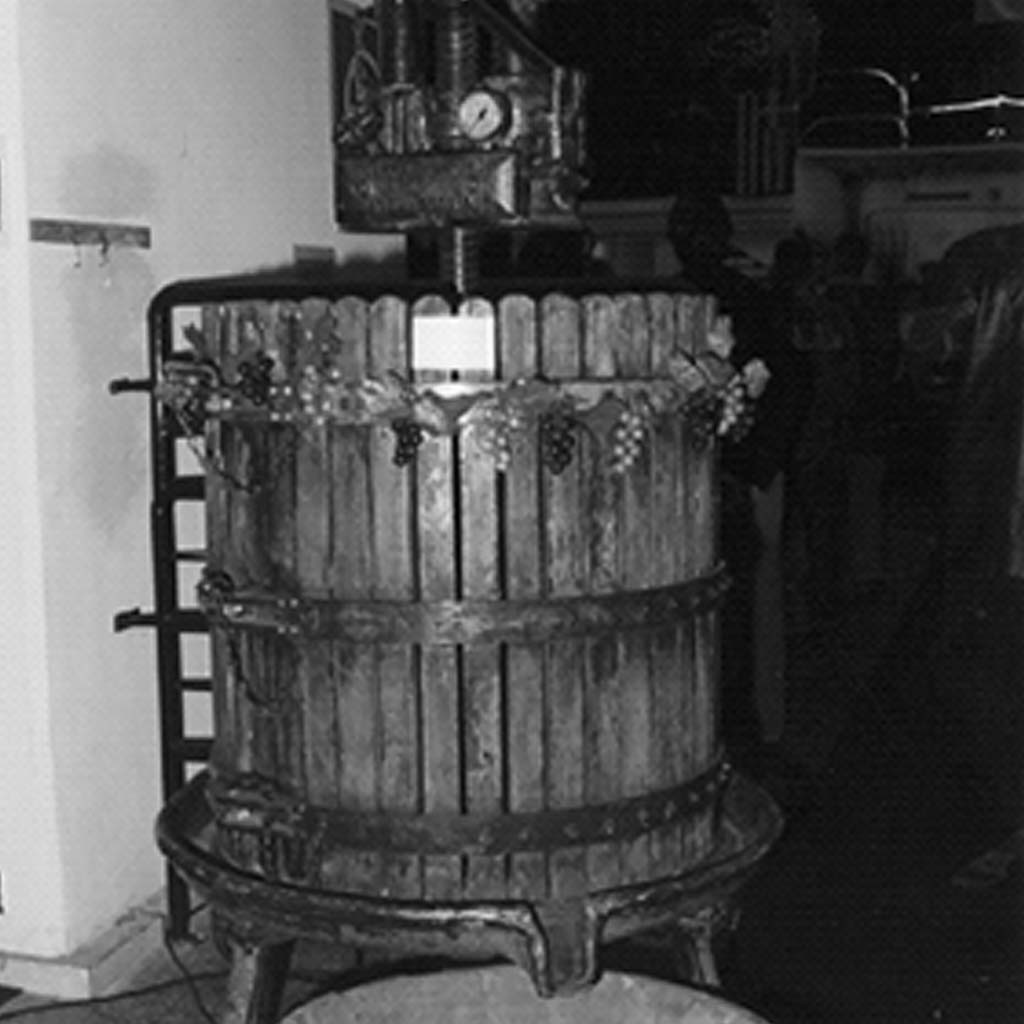
“There lived in Tyrnavos at the time an Armenian military doctor of the Turkish army, named Stavrak-bey, who was close friends with two prominent local men: Antonios Makris, a cloth merchant, and Dimitrios Doumenikiotis, a grocer and distiller. The three of them regularly enjoyed their midday and evening appetizer—the re-boiled raki, what we now call ouzo.”
“One day, Stavrak-bey, who clearly had a particular fondness for this drink, visited the workshop of D. Doumenikiotis and advised him right then and there to add a certain ingredient to improve its quality.
And indeed, when the distillation was done according to the doctor’s suggestion, and the three friends gathered to taste that day’s batch, Antonios Makris was the first to try it. Overjoyed, he exclaimed:
‘’Hey, what is this? This is ouzo Massalias!”
“And so, from that moment, the name ouzo was born.”
“Now, one may ask: what did the late Antonios Makris—the godfather of the word ouzo—mean by the phrase ouzo Massalias, from which the word ouzo remained as the name of this high-quality re-boiled raki?”
“In Tyrnavos, silkworm cultivation has long been practiced, producing large quantities of cocoons every year. The finest of these were wrapped in special bales and shipped to Volos for export to Europe, bearing the label uso Massalia, meaning ‘for use in Marseille.’”
“This phrase—uso Massalia—signified excellence in the cocoon trade. And that is what Makris meant with his exclamation, never imagining that he was creating a word that would endure.”
From Articles and Studies, edited by N. A. Tzartzanos, K. Kakoulidis Publications.
The MOSCHATO of TYRNAVOS
Moschato of Hamburg (Moschato Tyrnavou) is the dominant variety in the Tyrnavos region, cultivated on approximately 1,500 hectares. Although this variety appears sporadically around the world, in Greece it is uniquely identified with Tyrnavos, since almost all of its cultivation is concentrated in the wider area of the town.
The cultivation of Moschato began after the destruction of the historic Tyrnavos vineyard by phylloxera. Between 1930–1936, through the Agricultural School of Larisa and the distribution of phylloxera-resistant rootstocks, Moschato of Hamburg was introduced and gradually established.
The variety was originally created from a cross between the Italian Schiava Grossa (Trollinger or Black Hamburg) and the Egyptian Muscat of Alexandria. It was first grown in England’s greenhouses under the name Black Muscat of Alexandria, but eventually the name Moschato of Hamburg prevailed, combining elements from both parent varieties.
Moschato of Hamburg gradually spread almost worldwide—in Europe (France, Italy, Spain, Greece, Romania, Portugal, etc.), the United States (California, Virginia, Oregon, Texas), Egypt, Argentina, and more recently China.
In most regions where it is cultivated, it is used in wine blends, dessert wines, or consumed as a fresh grape. Rarely does one find wines made exclusively from Moschato of Hamburg.
The vine-growers of Tyrnavos, however—drawing on a centuries-old wine tradition—worked with the new post-phylloxera plantings and utilized Moschato in multiple ways: producing various aromatic wines (mainly light reds), distilling it to create the famous Tsipouro of Tyrnavos, and even promoting it as a table grape.
The extensive cultivation of Moschato of Hamburg in the area, its successful adaptation to the local environment, and its versatile use positioned Tyrnavos as an international point of reference for this variety. A testament to this is that in the global VIVC grape variety database, among the 105 synonyms of the variety—mostly variations of the name Moschato of Hamburg—a recognized synonym also appears: MOSCHATO TYRNAVOU.
This fact solidified Moschato Tyrnavou’s global reputation. Combined with the near-exclusive cultivation within the Municipality of Tyrnavos, it naturally led to efforts to officially register the name in national variety catalogs.
In February 2013, this was achieved: Moschato Tyrnavou was recognized nationally as an official synonym of Moschato of Hamburg—but only for grapes grown within the current boundaries of the Municipality of Tyrnavos.
Since then, the name Moschato Tyrnavou can be formally used for the grapes and all the products derived from them, replacing the “Hamburg” designation, which offered no benefit for promoting the region’s local products. A variety cultivated for so many decades, so closely linked with its land and its people, has become inevitably local in the minds of consumers.
Tyrnavos and Moschato now share a strong, mutually reinforcing identity: it is the Moschato of Tyrnavos, and Tyrnavos of Moschato, a relationship that will continue to shape the development of the region’s wine sector and its broader economy.
Efforts to officially recognize the variety were persistent and determined, despite an unfavorable environment. Stakeholders and institutions within the wine sector were initially skeptical that a dual-purpose variety from a lowland region—low in acidity and demanding in vinification—could stand among other popular Greek and international varieties.
But the variety’s inherent potential, expressed through the products derived from it, could not be overlooked—nor could the persistence of those who believed in it. As a result, in 2007, the variety became exclusively wine-producing in the Regional Unit of Larisa, and in 2008, it gained the right to produce Local Wines (now PGI wines). It was also granted eligibility to participate in all intervention measures of the EU’s CMO for wine—rights previously denied to dual-purpose varieties.
Throughout this journey of research, promotion, and recognition, one protagonist stood out: the Agricultural Cooperative Winery & Distillery of Tyrnavos, which over its 60-year history has produced numerous wine expressions and distillates (tsipouro) from Moschato. Special mention must be made of Asterios Papras, the oenologist and former Director of the Cooperative, whose scientific, technical, and institutional contribution—combined with his persistence—provided the necessary momentum for the variety’s elevation, resulting in growing consumer demand both in Greece and abroad.
It appears that the microclimate of Tyrnavos enhances the intense aromatic character of the variety—often reminiscent of roses—contributing to the production of distinctive Moschato wines. Particularly notable are semi-dry, semi-sweet, and sweet wines, where residual sugars amplify the aroma, as well as wines from selected vineyards (white, rosé, and red). Muscat varieties are also known globally for exceptional sparkling wines, and sparkling wines from Moschato Tyrnavou show excellent prospects in today’s market, where demand is rising. Thus, from a difficult and technically demanding variety, Tyrnavos has produced white, rosé, and red wines of all categories—PGI wines, varietal wines, sparkling wines—as well as tsipouro and other distillates.
The quality of distillates (tsipouro, etc.) made from Moschato Tyrnavou is a story on its own.
A research program (2006–2008) conducted with the participation of the Cooperative and Greek universities—titled “Highlighting the Distinctive Characteristics of Grape Pomace Distillate of Tyrnavos for the Production and Certification of High-Quality Tsipouro and Distillates”—revealed the tremendous value of the variety in distillation.
The results showed clear differentiation among the grape varieties studied, with Moschato Tyrnavou standing out in both the number and concentration of aromatic compounds. All experiments demonstrated that for Tsipouro of Tyrnavos to develop a distinct aromatic identity, it must be produced from pomace of Moschato Tyrnavou.
A key finding was the high linalool content, also confirmed in the grapes themselves. Comparisons with tsipouro from other regions and varieties showed that the aromatic profile of tsipouro is strongly tied to the grape variety used, and that distillates from Moschato Tyrnavou are characterized by specific compounds (linalool, o-trienol, and linalool oxides) absent in other varieties.
Part of this research was presented as a poster at the 2008 NATURAL PRODUCTS international conference in Athens, and based on its findings, the application file for the Geographical Indication Tsipouro of Tyrnavos was submitted to the European Union.
Tsipouro of Tyrnavos has been recognized as a Geographical Indication since 1989 under the first European spirits regulation (1576/1989). Tyrnavos is the only town in Greece to receive this distinction; other Greek GI regions refer to broad geographic areas (Thessaly, Macedonia, Crete). The variety Moschato Tyrnavou is what gives Tsipouro of Tyrnavos its unique identity and superior character.
The variety’s significance goes even further: Studies of polyphenols in by-products (pomace, stems, seeds) of Greek varieties have shown that Moschato Tyrnavou ranks among the top varieties in key bioactive compounds, with strong antioxidant, anticancer, and antimutagenic properties.
The superiority of Moschato Tyrnavou—its deep connection with the region, its traceability through laboratory analysis—all constitute a major advantage for the local wine sector and the local economy.
To capitalize on this, organized production structures are needed, such as a regional viticultural body to safeguard the product and develop its potential, supported by an appropriate institutional framework from the state.
As an epilogue, the most comprehensive Greek viticulture portal, New Wines of Greece (National Interprofessional Organization of Vine & Wine), offers the following description of Moschato of Hamburg:
“Unique among the various types of Muscat, Moschato of Hamburg stands out for its reddish berries. It is one of the few varieties vinified while also consumed as a table grape, thanks to its enticing aroma and flavor.
It is found in the vineyards of central Greece, especially Tyrnavos, where it predominates. Its explosive sweet aromas—reminiscent of clove essence—are its greatest strength. Although its low acidity and soft tannins rarely allow it to shine in single-varietal wines, its addition to blends works wonders. Even a small quantity can revive the dullest wine aromatically. But where it is truly unbeatable is in distillation, with the still acting as a magnifying glass for its virtues.
Rare, unusual, and modern, Moschato of Hamburg can open the door to red wines for new consumers and beautifully conclude any meal as a fine digestif.”
Anastasia Panagiotou
Agronomist – Oenologist at the Agricultural Cooperative Winery & Distillery of Tyrnavos